The Tin Stays: Inside America's 30-Year Love Affair With Candy Containers That Refuse to Die
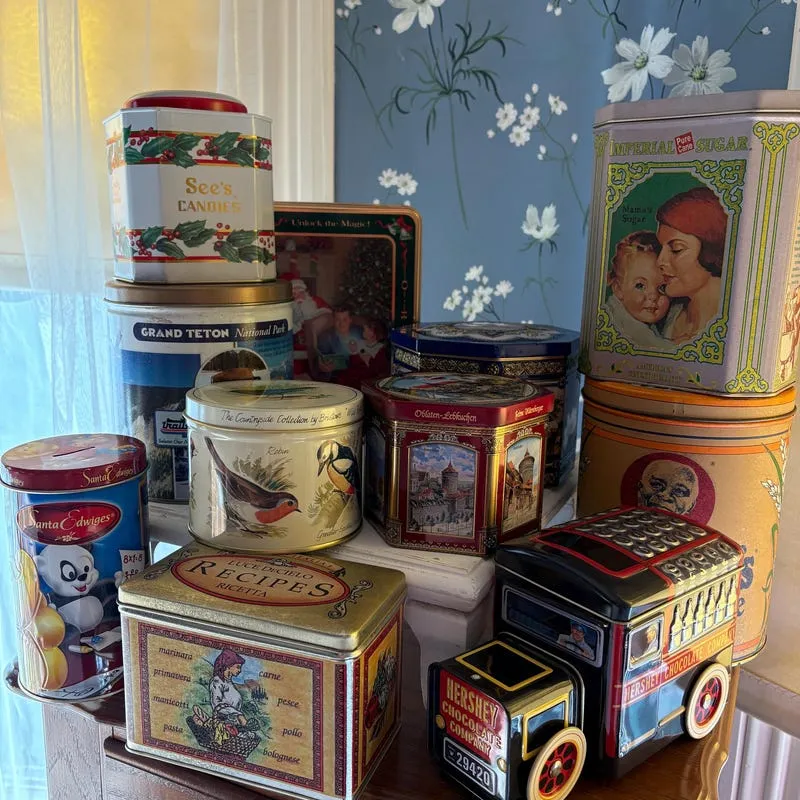
Photo: vintage candy tin collection stacked on table, via i.etsystatic.com
There's a universal law in American households, right up there with gravity: once a candy tin enters your life, it never leaves.
Nobody signs up for this. You buy a tin of butter mints at a Cracker Barrel in 1994, you eat the mints, and then — somehow — the tin is still in your kitchen in 2025, now holding rubber bands, loose buttons, or a single AA battery of unknown voltage. It has outlived three phones, two cars, and possibly a marriage.
We at Flash Mints needed to understand why. So we went looking for the people who take this phenomenon to its logical extreme: the collectors. The tin people.
The Grandma Industrial Complex
Ask any collector where the obsession started and you'll get the same answer: somebody's grandmother.
"My grandma had this dented blue biscuit tin she kept sewing supplies in," says Marlene Okafor, 52, who now owns over 400 vintage tins from her home in Dayton, Ohio. "When she passed, nobody fought over the jewelry. We fought over the tin. That's when I realized these things mean something."
She's not wrong. Walk through any estate sale in the Midwest and you'll find them: holiday tins from the '70s, buttermint tins with faded ballerinas on the lid, promotional tins from regional candy companies that haven't existed since the Reagan administration. Each one is a tiny time capsule with a hinged lid.
What's wild is how consistent the contents are. Open a random grandma tin in America and there is a 60% chance you'll find sewing needles, a 30% chance you'll find buttons, and a 10% chance you'll find the actual original candy, petrified into a state scientists would call "geological."
The eBay Underground
But grandma attics are only half the story. The other half lives online, where a thriving secondary market treats vintage candy tins like fine art.
Sealed mint tins from the 1990s — think Altoids commemorative editions, discontinued Starbucks after-coffee mints, promotional tins from brands that got sued out of existence — regularly fetch $40 to $150. One grail-level item, a sealed 1987 promotional peppermint tin from a defunct Detroit candy company, recently sold for over $600. The buyer, according to the listing, planned to "never open it" and "display it like the Mona Lisa."
"Condition is everything," explains Derek Voss, 38, a collector from Tucson who runs a tin-trading group with 12,000 members. "Unopened beats opened. Scratches kill the value. And rust? Rust is the end. These things were made of thin steel, and half of them spent decades in humid kitchens. Finding a mint-condition tin is genuinely hard. Which, yes, we've made the joke. Mint condition mint tins. We've all made it."
Everyone has made it. It's the law.
What's Inside Tells the Story
Here's where it gets interesting for candy nerds: the tins themselves are a fossil record of American taste.
Crack open the tins of the 1950s and '60s and you're looking at an era of buttermints, starlight mints, and cream-filled peppermints — soft, sweet, almost dessert-adjacent. By the '80s and '90s, the tins get smaller, sleeker, more aggressive. Strong mints. Breath-freshening mints. Mints marketed like they were tiny little weapons.
"The tins got louder as the mints got stronger," says Okafor. "The old tins look like they should hold tea. The '90s tins look like they should hold ammunition."
And the newest generation? They barely use tins at all — flip-top plastic, pocket-sized dispensers, single-serve everything. Which is exactly why the old tins are appreciating. They represent a moment when candy came in something you were expected to keep forever.
Why Nobody Can Let Go
We asked every collector the same question: why don't these tins get thrown away?
The answers were surprisingly sincere. The tins are durable, so throwing them away feels wasteful. They're attractive, so they earn shelf space. But underneath all the practical reasons, the real answer kept surfacing: a candy tin is a container that was given to you with something sweet inside, usually by someone who liked you.
"You can't throw away a tin," Voss told us, only half-joking. "Somebody's grandpa bought that at a truck stop and thought of them. It's a hug with a lid."
A hug with a lid. We couldn't have said it better ourselves.
So the next time you're at grandma's house and you see that dented blue tin on the dresser, show some respect. That tin has been holding down the family longer than you've been alive. And if you find one at an estate sale with the candy still sealed inside?
Do not open it. Some things are meant to stay in mint condition.